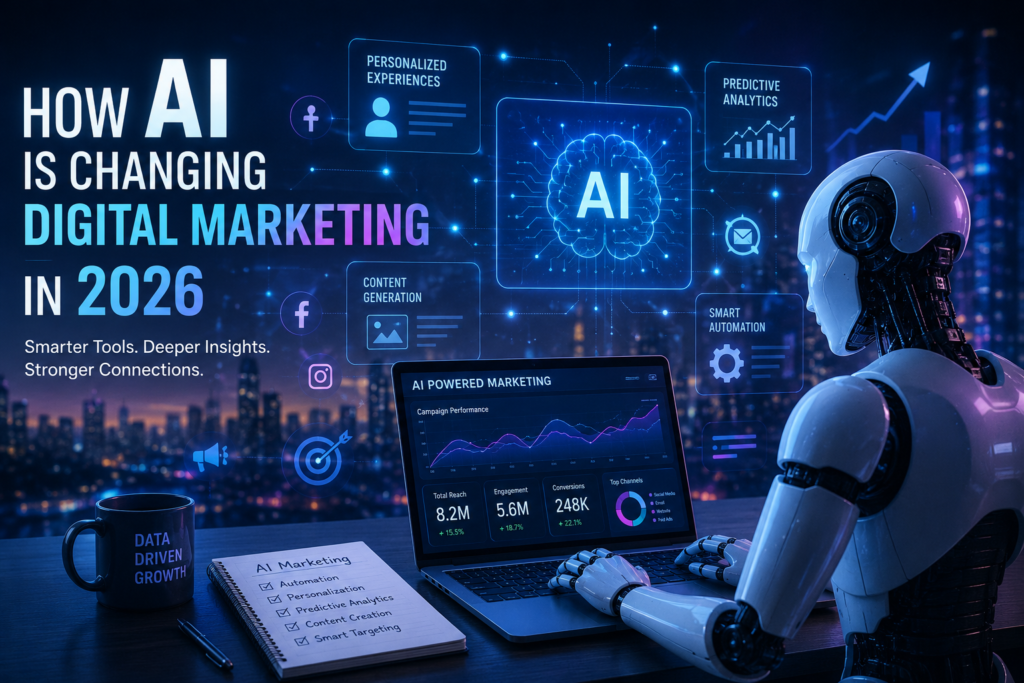
Artificial Intelligence in Digital Marketing
Artificial Intelligence in Digital Marketing , Imagine opening your favorite shopping app and finding exactly what you were thinking of buying. You scroll through Instagram, and every ad feels surprisingly relevant. You visit a website, ask a chatbot a question, and receive a personalized answer within seconds. Coincidence? Not at all. It’s Artificial Intelligence quitely working behind the scene.
In 2026, AI is no longer just a futuristic concept or a trendy buzzword—it’s the driving force behind modern digital marketing. Businesses of every size are using AI to understand customers better, create smarter campaigns, and deliver experiences that feel personal rather than promotional.
The question is no longer “Should I use AI?” It’s “Am I using AI effectively enough to stay ahead?”
Artificial Intelligence in Digital Marketing predicting future trends
Digital marketing has evolved dramatically over the last few years. What once required hours of manual work can now be accomplished in minutes with AI-powered tools. From generating content ideas and writing ad copy to analyzing customer behavior and predicting future trends, AI is helping marketers make faster and smarter decisions.
Here’s how AI is transforming digital marketing in 2026:
1. Hyper-Personalized Customer Experiences
Today’s consumers expect brands to understand their preferences. AI makes this possible by analyzing browsing habits, purchase history, and online behavior to deliver personalized recommendations, emails, and advertisements.
Instead of showing the same message to everyone, businesses can now create experiences tailored to each individual customer, increasing engagement and customer satisfaction.
2. Artificial Intelligence in Digital Marketing
Creating blogs, social media posts, email campaigns, and advertisements no longer starts with a blank page. AI assists marketers by generating ideas, optimizing headlines, suggesting keywords, and even drafting content.
While human creativity remains essential, AI speeds up the process, allowing marketers to focus more on strategy, storytelling, and brand identity.
3. Predictive Marketing
One of AI’s biggest strengths is its ability to identify patterns in data. Businesses can now predict customer behavior before it happens.
Whether forecasting purchasing trends, identifying potential leads, or estimating campaign performance, predictive analytics helps marketers invest their budget where it delivers the highest return.
4. Artificial Intelligence- Powered Customer Support
Modern chatbots have become intelligent virtual assistants capable of answering questions, recommending products, scheduling appointments, and resolving common issues—24 hours a day.
This not only improves customer satisfaction but also allows businesses to provide instant support without increasing operational costs.
5. Better Advertising with Less Waste
Artificial Intelligence in Digital Marketing continuously monitors advertising campaigns across platforms like Google and Meta. It automatically adjusts targeting, bidding strategies, budgets, and creatives based on real-time performance.
The result? Better conversions, lower advertising costs, and more efficient marketing campaigns.
Why Businesses Can’t Ignore Artificial Intelligence In Digital Marketing Anymore (Desire)
Artificial Intelligence in Digital Marketing , Imagine running a marketing campaign that knows exactly who your ideal customers are, what they want, and when they’re most likely to make a purchase.
That’s the advantage AI provides.
Businesses using AI are experiencing:
-
- Faster campaign execution
-
- Improved customer engagement
-
- Higher conversion rates
-
- Better return on advertising spend
-
- Smarter decision-making through real-time insights
-
- Increased productivity with marketing automation
However, AI is not replacing marketers—it is empowering them.
The most successful brands in 2026 combine AI’s speed and data-processing capabilities with human creativity, emotional intelligence, and strategic thinking. Technology can generate content, but it still takes people to build trust, tell compelling stories, and create meaningful connections.
The marketers who thrive are those who learn how to collaborate with AI instead of competing against it.
Artificial Intelligence in Digital Marketing
AI is no longer an optional tool reserved for large corporations. Today, startups, small businesses, and established enterprises all have access to affordable AI-powered marketing solutions.
If your business hasn’t started leveraging AI yet, now is the perfect time to begin.
Start by:
-
- Using AI to research customer insights.
-
- Automating repetitive marketing tasks.
-
- Personalizing email and social media campaigns.
-
- Optimizing SEO and content strategies.
-
- Analyzing campaign performance with AI-driven reports.
Small improvements today can create significant competitive advantages tomorrow.
Final Thoughts (Artificial Intelligence in Digital Marketing)
Every major shift in marketing has rewarded those who embraced change early. Social media transformed how brands connected with audiences. Mobile technology changed consumer behavior. Now, Artificial Intelligence is redefining digital marketing once again. Digital Marketing
AI isn’t here to replace creativity—it enhances it. It doesn’t replace marketers—it empowers them to work smarter, move faster, and deliver more meaningful customer experiences.
In 2026, success isn’t determined by who spends the most on marketing. It’s determined by who understands their audience best, adapts the fastest, and uses AI to create value at every stage of the customer journey.
The future of digital marketing isn’t powered by technology alone—it’s powered by marketers who know how to combine human creativity with intelligent innovation.
The Future Isn’t Coming—It’s Already Here
Artificial Intelligence , Imagine opening your favorite shopping app and finding exactly what you were thinking of buying. You scroll through Instagram, and every ad feels surprisingly relevant. You visit a website, ask a chatbot a question, and receive a personalized answer within seconds. Coincidence? Not at all. It’s Artificial Intelligence quietly working behind the scenes.
In 2026, AI is no longer just a futuristic concept or a trendy buzzword—it’s the driving force behind modern digital marketing. Businesses of every size are using AI to understand customers better, create smarter campaigns, and deliver experiences that feel personal rather than promotional.
The question is no longer “Should I use AI?” It’s “Am I using AI effectively enough to stay ahead?”
AI Is Revolutionizing the Way Brands Market (Attention & Interest)
Digital marketing has evolved dramatically over the last few years. What once required hours of manual work can now be accomplished in minutes with AI-powered tools. From generating content ideas and writing ad copy to analyzing customer behavior and predicting future trends, AI is helping marketers make faster and smarter decisions.
Here’s how AI is transforming digital marketing in 2026:
1. Hyper-Personalized Customer Experiences
Today’s consumers expect brands to understand their preferences. AI makes this possible by analyzing browsing habits, purchase history, and online behavior to deliver personalized recommendations, emails, and advertisements.
Instead of showing the same message to everyone, businesses can now create experiences tailored to each individual customer, increasing engagement and customer satisfaction.
2. Smarter Content Creation
Creating blogs, social media posts, email campaigns, and advertisements no longer starts with a blank page. AI assists marketers by generating ideas, optimizing headlines, suggesting keywords, and even drafting content.
While human creativity remains essential, AI speeds up the process, allowing marketers to focus more on strategy, storytelling, and brand identity.
3. Artificial Intelligence in Digital Marketing
One of AI’s biggest strengths is its ability to identify patterns in data. Businesses can now predict customer behavior before it happens.
Whether forecasting purchasing trends, identifying potential leads, or estimating campaign performance, predictive analytics helps marketers invest their budget where it delivers the highest return.
4. AI-Powered Customer Support
Modern chatbots have become intelligent virtual assistants capable of answering questions, recommending products, scheduling appointments, and resolving common issues—24 hours a day.
This not only improves customer satisfaction but also allows businesses to provide instant support without increasing operational costs.
5. Better Advertising with Less Waste
AI continuously monitors advertising campaigns across platforms like Google and Meta. It automatically adjusts targeting, bidding strategies, budgets, and creatives based on real-time performance.
The result? Better conversions, lower advertising costs, and more efficient marketing campaigns.
Why Businesses Can’t Ignore Artificial Intelligence Anymore (Desire)
Imagine running a marketing campaign that knows exactly who your ideal customers are, what they want, and when they’re most likely to make a purchase.
That’s the advantage AI provides.
Businesses using AI are experiencing:
-
- Faster campaign execution
-
- Improved customer engagement
-
- Higher conversion rates
-
- Better return on advertising spend
-
- Smarter decision-making through real-time insights
-
- Increased productivity with marketing automation
However, AI is not replacing marketers—it is empowering them.
The most successful brands in 2026 combine AI’s speed and data-processing capabilities with human creativity, emotional intelligence, and strategic thinking. Technology can generate content, but it still takes people to build trust, tell compelling stories, and create meaningful connections.
The marketers who thrive are those who learn how to collaborate with AI instead of competing against it.
The Future Belongs to Businesses That Adapt (Action)
AI is no longer an optional tool reserved for large corporations. Today, startups, small businesses, and established enterprises all have access to affordable AI-powered marketing solutions.
If your business hasn’t started leveraging AI yet, now is the perfect time to begin.
Start by:
-
- Using AI to research customer insights.
-
- Automating repetitive marketing tasks.
-
- Personalizing email and social media campaigns.
-
- Optimizing SEO and content strategies.
-
- Analyzing campaign performance with AI-driven reports.
Small improvements today can create significant competitive advantages tomorrow.
Final Thoughts
Every major shift in marketing has rewarded those who embraced change early. Social media transformed how brands connected with audiences. Mobile technology changed consumer behavior. Now, Artificial Intelligence is redefining digital marketing once again.
AI isn’t here to replace creativity—it enhances it. It doesn’t replace marketers—it empowers them to work smarter, move faster, and deliver more meaningful customer experiences.
In 2026, success isn’t determined by who spends the most on marketing. It’s determined by who understands their audience best, adapts the fastest, and uses AI to create value at every stage of the customer journey.
The future of digital marketing isn’t powered by technology alone—it’s powered by marketers who know how to combine human creativity with intelligent innovation.